
Why Does a Commercial Heating System Keep Losing Pressure?
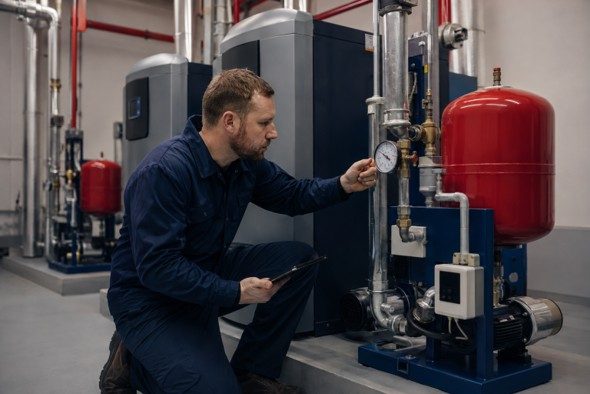
A sealed commercial heating system should maintain a stable pressure appropriate to the building height, system design and equipment requirements.
Some movement in pressure between a cold system and a fully heated system is normal. Water expands as it heats and contracts again as it cools, and the expansion vessel is designed to accommodate that change.
What is not normal is:
- Regularly having to top the system up
- A pressurisation unit continually adding water
- Repeated low-pressure alarms
- Boiler lockouts caused by low system pressure
- Pressure falling substantially overnight
- Pressure rising excessively when the system heats
- Water regularly discharging from a safety valve
These symptoms indicate that something within the heating system needs investigating.
Simply adding more water may restore the heating temporarily, but it does not repair the underlying fault.
In fact, continually topping up a sealed heating system can create additional problems by introducing fresh oxygen and minerals into the system water and diluting the existing corrosion inhibitor.
The correct solution is to establish where the pressure is going and why.
How Does Pressure Work in a Commercial Sealed Heating System?
Unlike an open-vented heating system, a sealed heating system is maintained under pressure.
Commercial installations commonly use a pressurisation unit to maintain the required minimum system pressure and replace small quantities of water lost from the system.
An expansion vessel accommodates the increase in water volume that occurs as the heating system warms up.
Both components need to be correctly selected, commissioned and maintained.
The correct system pressure depends on factors including:
- Building height
- Location of the plant room
- Height of the highest heating circuit
- Boiler or heat-pump requirements
- System design
- Expansion-vessel arrangement
- Pressurisation-unit settings
There is therefore no single pressure that is correct for every commercial heating system.
A three-storey office and a fifteen-storey building can require very different pressure arrangements.
Is It Normal for Heating-System Pressure to Rise When Hot?
Yes, some increase is normal.
As the heating water becomes hotter, its volume increases.
The expansion vessel provides space for this increased volume while helping keep the system pressure within its intended operating range.
When the system cools again, the water contracts and the pressure should return reasonably close to its original cold condition.
A large pressure swing, however, can indicate a problem.
For example, if the system starts at a normal cold pressure, rises close to the safety-valve setting when hot and then falls below its normal operating pressure when cold, the expansion system should be investigated.
First Establish How Quickly the Pressure Is Falling
The rate of pressure loss can provide useful information.
Before repeatedly filling the system, record:
- System pressure when cold
- System pressure during normal operation
- Maximum pressure when fully heated
- Pressure after the system cools again
- How frequently the pressurisation unit operates
- How much make-up water is being used
- Whether safety valves discharge
- Whether boiler lockouts coincide with the pressure loss
A system losing pressure over several weeks may require a different investigation from one losing pressure within hours.
For larger buildings, useful evidence may already be available from:
- BMS pressure trends
- Boiler fault histories
- Pressurisation-unit alarms
- Water-meter readings
- Maintenance records
- Previous service reports
- Historic expansion-vessel checks
Trend information can be particularly helpful where a leak or pressure fault is intermittent.
Common Causes of Pressure Loss in Commercial Heating Systems
1. A Visible Water Leak
The most obvious cause is a leak somewhere on the heating circuit.
Potential leak points include:
- Valve glands
- Flanges
- Threaded connections
- Press fittings
- Welded joints
- Pump seals
- Flexible connections
- Automatic air vents
- Radiators
- Fan-coil units
- Air-handling-unit coils
- Control valves
- Drain points
- Boiler connections
- Heat-pump connections
- Plate heat exchangers
- Header arrangements
Even a relatively small leak can cause a large sealed system to require regular make-up water.
2. A Concealed Heating-System Leak
Not every leak produces an obvious puddle in the plant room.
Commercial heating systems can extend through:
- Ceiling voids
- Service risers
- Floor voids
- Underground ducts
- Plant areas
- Roof plant rooms
- Remote air-handling units
- Tenant areas
- Warehouses
- External plant
A boiler-room low-pressure alarm may therefore be caused by water loss hundreds of metres away.
Hot heating water can also evaporate from a small leak before a noticeable pool develops.
Signs can include:
- White or coloured deposits
- Corrosion
- Staining
- Damp insulation
- Rust marks
- Discoloured ceiling tiles
- Green deposits on copper
- Water marks around valves
- Damaged pipe insulation
The entire connected system should therefore be considered rather than assuming the fault must be beside the boilers.
3. Expansion-Vessel Problems
Expansion-vessel faults are one of the most important things to investigate where system pressure changes significantly between hot and cold conditions.
The expansion vessel normally contains a flexible diaphragm separating the system water from a compressed gas charge.
As heating water expands, water enters the vessel and compresses the gas cushion.
Problems can occur if:
- The vessel has lost its pre-charge
- The diaphragm has failed
- The vessel is undersized
- The vessel has become waterlogged
- The vessel connection is blocked
- An isolation valve has been closed
- The vessel pre-charge is incorrect
- The system cold-fill pressure is incorrect
- Additional system volume has been added without reviewing expansion capacity
If the expansion vessel cannot accept the expanding water volume, system pressure can rise considerably as the boilers heat.
The pressure-relief valve may then discharge water.
When the system cools, there is now less water in the circuit and the pressure falls.
This can create the classic pattern of:
normal cold pressure → excessive hot pressure → safety-valve discharge → very low cold pressure
Simply topping the system up repeats the cycle.
How Is a Commercial Expansion Vessel Checked?
Expansion-vessel testing should be carried out correctly rather than relying simply on tapping the side of the vessel.
The engineer should consider:
- Vessel size
- System volume
- Pre-charge pressure
- Cold-fill pressure
- Static head
- Vessel connection
- Isolation valves
- Diaphragm condition
- System temperature range
The manufacturer’s procedures should be followed when checking the vessel pre-charge.
A pre-charge measurement normally requires the water side of the vessel to be at the appropriate depressurised condition; reading it against full system pressure will not provide a meaningful result.
Large commercial systems may contain several expansion vessels and considerably greater water volumes than domestic installations, making correct sizing particularly important.
4. Pressure-Relief or Safety-Valve Discharge
A heating-system safety valve is designed to protect the system against excessive pressure.
If system pressure exceeds its set point, the valve opens and allows water to discharge.
Possible reasons include:
- Failed expansion vessel
- Incorrect vessel charge
- Undersized expansion capacity
- Excessive filling pressure
- Pressurisation-unit fault
- Incorrect controls
- System overheating
- Safety-valve fault
Once a safety valve has operated, it may also fail to reseat completely because dirt or debris becomes trapped on the valve seat.
A small continuous discharge can then gradually reduce system pressure.
The discharge route should be inspected safely for evidence of water loss.
A safety-valve discharge must never be capped, plugged or isolated simply to stop the leak.
The cause of the discharge needs to be identified.
5. Pressurisation-Unit Problems
Many larger commercial sealed heating systems use an automatic pressurisation unit rather than relying on manual filling.
Its purpose is to maintain the system’s required minimum pressure.
Potential faults can include:
- Incorrect pressure settings
- Failed pumps
- Pump wear
- Faulty pressure sensors
- Blocked strainers
- Failed valves
- Electrical faults
- Control faults
- Isolated water supply
- Empty break tank
- Level-control problems
- Incorrect commissioning
However, an important distinction needs to be made.
A Pressurisation Unit Running Frequently May Not Be Faulty
If a pressurisation unit is repeatedly adding water, it may actually be doing exactly what it has been designed to do.
The real problem could be that water is continually leaving the heating system somewhere else.
Changing the pressurisation unit without first investigating the water loss can therefore fail to resolve the problem.
Where possible, record how frequently the unit operates and how much make-up water is being introduced.
6. Leaking Automatic Air Vents
Automatic air vents are designed to remove trapped air from the system.
They can also become a source of water loss.
Possible issues include:
- Worn seals
- Dirt on the valve mechanism
- Corrosion
- Incorrect installation
- Excessive pressure
- Mechanical failure
A leaking air vent in a roof plant room or ceiling void can go unnoticed for a long period.
7. Pump-Seal Leaks
Pump seals may leak:
- Continuously
- Only when the pump is operating
- Only when hot
- Only under a particular differential pressure
A pump may therefore appear dry during an inspection when the plant is off and begin leaking once it returns to normal operation.
Look for deposits and staining around the pump body and seal area rather than relying solely on whether water is visibly leaking at that moment.
8. Internal Heat-Exchanger Leakage
Heat exchangers can occasionally develop internal leaks.
Depending on the system arrangement, heating water may then escape into another circuit or through another route without becoming immediately visible in the plant room.
Plate heat exchangers, calorifier coils and other interfaces between water systems should therefore be considered where the obvious external system is dry.
The investigation depends heavily on the plant arrangement and should be carried out by engineers familiar with the particular equipment.
9. Air Trapped After Maintenance
Pressure instability immediately following:
- Drain-down
- Boiler replacement
- Pump replacement
- Radiator works
- Valve replacement
- Major heating repairs
may initially be associated with air being removed from the system.
As trapped air vents from high points and automatic vents, system pressure can fall.
A limited amount of adjustment following substantial maintenance can therefore be expected.
However, continued make-up after the system has been properly filled, vented and commissioned should be investigated.
10. Recent Modifications to the Heating System
Changes to a building can affect the original pressure and expansion design.
Examples include:
- New heating circuits
- Additional radiators
- New AHU coils
- Building extensions
- Additional boilers
- Heat-pump installations
- New buffer vessels
- Additional system volume
Increasing the total system water content can increase the expansion volume.
If the existing expansion arrangement is not reviewed after significant alterations, the original vessel capacity may no longer be adequate.
Why Continually Topping Up a Commercial Heating System Is a Problem
Automatically or manually adding water can keep a system operating temporarily.
It should not become the permanent solution to unexplained pressure loss.
Fresh make-up water can introduce additional:
- Dissolved oxygen
- Minerals
- Hardness
- Dissolved solids
It can also dilute any existing chemical treatment or corrosion inhibitor within the heating circuit.
Corrosion
Oxygen within heating-system water contributes to corrosion of ferrous components.
Corrosion can produce magnetite, commonly recognised as black sludge.
This material can accumulate in:
- Boilers
- Heat exchangers
- Pumps
- Control valves
- Strainers
- Radiators
- Low-flow sections of pipework
Blocked Strainers
Corrosion debris can accumulate in strainers and reduce water flow.
This can lead to:
- Poor heating performance
- Boiler flow faults
- Pump problems
- Temperature alarms
Pump Damage
Poor system-water quality and debris can contribute to pump wear, blocked impellers and seal problems.
Reduced Heat Transfer
Deposits within heat exchangers can impair heat transfer and contribute to reduced plant performance.
Diluted Inhibitor
Where a heating system contains corrosion inhibitor, repeated addition of untreated water can reduce its concentration.
Water treatment should therefore form part of the investigation where substantial make-up water has entered the system.
Should a Commercial Heating System Need Any Make-Up Water?
Very small losses can occur over the life of a large system, particularly following maintenance or venting.
The purpose of a pressurisation unit includes maintaining the required minimum system pressure and replacing limited water losses.
However, regular or substantial make-up water consumption should not simply be accepted as normal operation.
Where the unit is frequently filling the system, the reason should be established.
For critical or larger sites, monitoring make-up water usage can provide a useful early warning of developing problems.
A Useful Diagnostic Pattern: Pressure Rises High Then Falls Low
One particularly useful symptom is:
- System pressure appears normal when cold.
- The boilers operate.
- Pressure rises rapidly as the heating water warms.
- The safety valve opens or discharges.
- The system eventually cools.
- Pressure is now considerably lower.
- The pressurisation unit adds more water.
- The cycle repeats.
This pattern strongly justifies investigation of the expansion-vessel and pressure-control arrangement.
It does not, by itself, prove a particular component has failed, so the system still needs to be tested correctly.
A Different Pattern: Pressure Slowly Falls With Little Hot/Cold Variation
If pressure falls gradually while the normal difference between hot and cold pressures remains reasonable, an actual water loss becomes an important possibility.
The investigation may then focus more heavily on:
- Pipework
- Plant
- Remote heating circuits
- Safety-valve discharge
- Automatic air vents
- Pump seals
- Heat exchangers
- Make-up water records
Again, the symptoms guide the investigation rather than replacing proper testing.
Using the BMS to Diagnose Pressure Loss
Larger commercial buildings often already collect information that can help identify the problem.
A BMS may provide trends for:
- System pressure
- Flow temperature
- Return temperature
- Boiler operation
- Pump operation
- Low-pressure alarms
- High-pressure alarms
- Plant enable signals
Comparing these trends can show whether the pressure loss happens:
- When the boilers start
- Overnight
- During high-temperature operation
- When a particular pump runs
- Following a high-pressure event
- During periods when the plant is off
Where pressurisation-unit data or make-up water metering is also available, this can significantly narrow the investigation.
What Should a Commercial Pressure-Loss Investigation Include?
The exact scope depends on the system, but a structured investigation may include:
Plant-Room Inspection
Check:
- Boilers
- Pumps
- Expansion vessels
- Pressurisation units
- Safety valves
- Air vents
- Flanges
- Control valves
- Strainers
- Heat exchangers
- Headers
- Visible pipework
Pressure Testing and Trending
Record pressure under:
- Cold conditions
- Warm-up
- Normal operating temperature
- Shutdown
- Cool-down
Expansion-Vessel Assessment
Check:
- Correct sizing
- Pre-charge
- Connection
- Isolation
- Diaphragm condition
- Relationship with system cold-fill pressure
Pressurisation-Unit Assessment
Check:
- Control settings
- Pumps
- Sensors
- Alarms
- Break tank where fitted
- Water supply
- Frequency of operation
Remote-System Inspection
Inspect where accessible:
- Heating risers
- Ceiling voids
- Radiators
- Fan-coil units
- AHU heating coils
- Remote plant
- Roof plant
- Tenant areas
System-Water Condition
Where repeated filling has occurred, consideration should also be given to:
- Inhibitor concentration
- System-water condition
- Corrosion
- Magnetite
- Strainers
- Dirt separation
- Water treatment requirements
Gas Boilers and Safety
A loss of heating-system water pressure is a hydraulic problem and does not automatically mean there is a gas fault.
However, where diagnostic or repair work involves a gas appliance, gas fitting or gas-safety function, the relevant work must be carried out by appropriately competent and registered personnel.
Commercial gas boilers also need to be maintained appropriately, including consideration of the appliance, associated gas installation and flue arrangements as applicable.
If there is concern regarding:
- Gas leakage
- Combustion safety
- Carbon monoxide
- Unsafe boiler operation
- Damaged flues
the equipment should not simply be repeatedly reset.
The site’s appropriate gas-safety and emergency procedures should be followed.
When Should Pressure Loss Be Treated as Urgent?
Arrange urgent investigation where there is:
- Rapid pressure loss
- An active water leak
- Water affecting electrical equipment
- Regular safety-valve discharge
- Major water damage
- Repeated boiler lockouts
- Complete loss of heating
- Loss of heating to a healthcare facility
- Loss of heating to a school or care environment
- Loss of heating affecting business-critical processes
- A suspected gas or combustion-safety problem
A minor pressure decline over a long period may allow investigation to be planned.
A system that loses its pressure within hours should not simply be topped up repeatedly.
Frequently Asked Questions
Is It Normal for Commercial Heating-System Pressure to Change?
Some pressure movement between cold and hot operating conditions is normal.
Water expands as it heats and the expansion vessel accommodates that increase in volume.
Large pressure swings, repeated low-pressure conditions or regular make-up water use are not something that should simply be accepted.
What Pressure Should a Commercial Heating System Run At?
There is no universal figure.
The correct pressure depends on the system design, including building height, static head, plant location and equipment requirements.
The design documentation and plant manufacturer’s requirements should be checked.
Why Does My Heating Pressure Rise When the Boilers Run?
Some rise is normal as system water heats.
An unusually large increase can be associated with problems involving the expansion vessel, system fill pressure or expansion capacity.
Why Does My Heating Pressure Drop When the System Cools?
Some reduction from the hot pressure is normal.
If the system drops below its intended cold-fill pressure, particularly after the pressure has risen excessively while hot, the expansion arrangement and any safety-valve discharge should be investigated.
Can I Just Keep Topping Up the Heating System?
An occasional controlled adjustment following maintenance may be appropriate.
Repeated topping up is not a satisfactory long-term solution to unexplained pressure loss.
Fresh make-up water can also affect system-water quality and dilute existing chemical treatment.
Does Low Pressure Mean the Boiler Is Leaking?
No.
The water loss may be anywhere on the connected heating system.
Possible causes include:
- Pipework leaks
- Expansion-vessel faults
- Safety-valve discharge
- Pump seals
- Air vents
- Pressurisation equipment
- Remote heating coils
- Heat exchangers
Why Does My Pressurisation Unit Keep Running?
It may have a fault, but it may also be responding correctly to falling system pressure caused by water loss elsewhere.
The make-up frequency and quantity should be investigated before assuming the pressurisation unit itself requires replacement.
Can an Expansion Vessel Cause Low Pressure?
Yes.
A failed or incorrectly charged expansion vessel can allow pressure to rise excessively when the system heats.
The safety valve may then discharge water, leaving the system at low pressure once it cools.
How Do I Know if the Expansion Vessel Has Failed?
Symptoms can include:
- Large hot-to-cold pressure changes
- Rapid pressure rise during warm-up
- Safety-valve discharge
- Repeated low-pressure alarms after cool-down
These symptoms justify proper expansion-vessel testing but are not, by themselves, proof of failure.
Why Is Water Coming From the Heating Safety Valve?
The valve may be protecting the system from excessive pressure, or it may not have reseated correctly after operating.
The underlying cause should be diagnosed.
The discharge must not be capped or isolated to stop the symptom.
Can a Small Leak Cause a Large Commercial System to Lose Pressure?
Yes.
Even relatively small continuous leaks can cause significant make-up water consumption over time.
Leaks can also occur in remote or concealed sections of a commercial heating installation.
Does Repeated Topping Up Cause Sludge?
Repeated fresh-water addition can increase oxygen and mineral input and dilute corrosion inhibitor.
This can contribute to corrosion and the formation of deposits such as magnetite in susceptible systems.
Can a BMS Help Find a Pressure Fault?
Yes.
Historic pressure, temperature, boiler and pump trends can help identify when pressure changes occur and whether they correspond with plant operation.
Commercial Heating Pressure-Loss Investigation
Cherwell Heating supports commercial clients across Oxfordshire and Buckinghamshire with the diagnosis, repair and maintenance of commercial heating and plant-room systems.
We work with:
- Offices
- Schools
- Hotels
- Healthcare facilities
- Industrial buildings
- Warehouses
- Commercial landlords
- Managing agents
- Facilities-management companies
We can investigate:
- Repeated heating-system pressure loss
- Expansion-vessel problems
- Pressurisation-unit faults
- Safety-valve discharge
- Commercial boiler faults
- Pump problems
- Heating-system leaks
- Poor circulation
- Air and dirt problems
- Heating-system water quality
- Control faults
- Plant-room defects
Rather than repeatedly adding water and resetting the boilers, our aim is to establish why the pressure is falling and identify the appropriate remedial work.
If your commercial heating system is repeatedly losing pressure, contact Cherwell Heating to arrange a structured plant-room and heating-system investigation.