

Commercial Heating Condition Surveys: What Facilities Managers Should Expect
When facilities managers need a five-year budget or an answer on plant-room risk, another routine service report may not be enough. A commercial heating condition survey examines the wider system, records asset condition and turns observations into prioritised maintenance, resilience and replacement actions.
The value lies in the output. A good survey should help a non-specialist understand what is installed, what could fail, what requires further testing and where money should be allocated—not deliver a folder of unexplained photographs.
Condition survey versus planned service
A planned service follows the manufacturer’s and contract’s maintenance tasks to keep equipment operating safely and reliably. It may identify defects, but its main purpose is not to produce a long-term estate strategy.
A condition survey looks across boilers, burners, pumps, vessels, pressurisation, valves, controls, distribution and plant-room infrastructure. It considers age, observed state, maintainability, obsolescence, performance evidence and consequences of failure. Servicing and surveying complement rather than replace each other.
What happens before the site visit?
The surveyor should agree buildings, systems, access, operational constraints and the level of detail required. Useful records include drawings, asset lists, service and breakdown history, gas-safety information, water-treatment reports, BMS data, energy use, previous surveys and planned refurbishments.
Tell the surveyor about persistent comfort complaints and business-critical areas. A heating failure in a warehouse office, care environment and data-led operation may carry very different consequences, even if the boilers look similar.
What the plant-room inspection covers
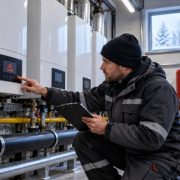
The inspection normally verifies assets and labels, records make, model, age and capacity where accessible, and reviews visible condition. It should consider combustion plant, flues, ventilation, gas train, pumps, strainers, pressurisation and expansion, water condition, insulation, leaks, corrosion, supports, electrical panels and controls.
The surveyor will look for accessibility and maintainability as well as deterioration. A component may operate today but be boxed in, unsupported by its manufacturer or impossible to isolate without shutting down the building. Those are genuine future risks.
Operational checks and further testing
Where permissions and conditions allow, the survey may include functional observation, temperatures, pressures, control responses and evidence of lead/lag operation. Thermal imaging can highlight unusual patterns, but it is a screening tool rather than proof of every fault.
Some questions require intrusive tests, combustion analysis, electrical testing, water sampling or specialist flue inspection. A responsible report distinguishes what was observed from what remains to be tested, with no implied guarantee about concealed systems.
How findings should be graded
A useful report combines condition with risk. It should distinguish immediate safety or continuity actions, short-term repairs, planned medium-term work and longer-term opportunities. Each priority needs a reason, recommended next step and dependencies.
Avoid treating a single condition letter as the whole answer. An older boiler with good redundancy and parts support may be a lower operational risk than a newer single boiler with repeated control failures. Consequence, likelihood and recovery options all matter.
What the final report should contain
Expect an executive summary, verified asset schedule, scope and limitations, photographs, findings by system, defect and risk register, recommended tests, prioritised actions and an outline life-cycle plan. Budget bands can support planning, provided assumptions and exclusions are clear; they are not substitutes for competitive project quotations.
The report should also identify quick wins such as control corrections, insulation repairs, balancing or maintenance access, alongside capital items. This helps facilities teams separate operational improvement from wholesale replacement.
When to commission a survey
Typical triggers include acquisition or lease handover, inconsistent records, repeat failures, insurance or governance reviews, preparation of capital budgets, decarbonisation studies and the years before known plant end of life. Surveying while the system still operates leaves more choices than waiting for emergency replacement.
Cherwell Heating surveys and maintains commercial heating plant across Oxfordshire and surrounding counties, with practical reporting designed for facilities decisions and contractor action.
Frequently asked questions
How long does a commercial heating condition survey take?
It depends on estate size, access, records and the level of testing. Agree the scope and deliverables first rather than buying a fixed number of hours without context.
Will the survey confirm that every boiler is safe?
A condition survey is not a substitute for required servicing, gas-safety work or specialist tests. The report should clearly state its limitations and any further checks required.
Does the report include replacement costs?
It can include planning-level budget bands when requested. Firm project costs normally require a developed scope, design and quotation.
Should the heating be running during the survey?
Operational observation is useful, but access and seasonal conditions vary. The surveyor should state what was tested, what was observed and what could not be verified.
Next step
Need a defensible heating asset plan rather than another list of faults? Contact Cherwell Heating for a scoped commercial plant-room condition survey.









Leave a Reply
Want to join the discussion?Feel free to contribute!