
Commercial Boiler Lockout in Cold Weather: Safe Firth Checks
A commercial boiler lockout is a safety response, not the underlying fault. The boiler control has detected a condition that prevents normal operation and has stopped the burner or appliance.
For facilities managers, landlords and businesses in Oxfordshire and Buckinghamshire, a boiler lockout can quickly affect staff comfort, tenant welfare, building operations and hot-water availability. On a cold morning, it can be tempting to keep resetting the boiler. However, repeated resets can remove useful fault information and delay an accurate diagnosis.
The safest approach is to record the fault, check the wider heating system and arrange qualified support where needed. Commercial boiler systems are often part of a larger plant-room installation, with cascade boilers, pumps, pressurisation equipment, valves and BMS controls. The display on one boiler is only part of the picture.
What does a commercial boiler lockout mean?
Modern commercial gas boilers monitor ignition, flame detection, temperature, pressure, airflow and other safety conditions. If the boiler does not receive the expected confirmation during its operating sequence, it may lock out and display a fault code or message.
Common commercial boiler lockout categories include:
- Ignition failure
- Flame-signal faults
- Low system pressure
- Overheating
- Fan or airflow faults
- Condensate drainage problems
- External control or safety-interlock faults
The meaning of a fault code is specific to the boiler manufacturer and model. Always use the manufacturer’s instructions for the displayed code rather than relying on a generic online fault-code list.
Safe checks before arranging commercial boiler repair
Record the exact boiler fault information
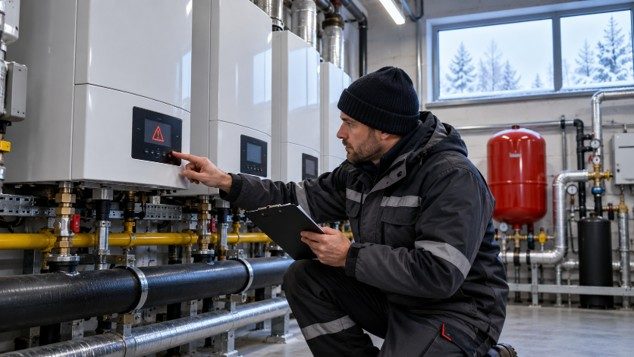
Photograph the boiler display before resetting anything. Note the exact fault code, which boiler is affected and whether it is part of a cascade installation.
Also record:
- The time the lockout occurred
- Outdoor and plant-room temperatures
- Whether heating or hot water is affected
- Whether the fault returns after a permitted reset
- Any relevant BMS alarm history, where you have authorised access
This information helps the attending engineer diagnose the cause more efficiently.
Check whether the whole building is affected
Confirm whether there is no heat throughout the building, one cold area, no hot water, or reduced heating output because one boiler in a cascade is offline.
This helps identify whether the fault is likely to be within the boiler itself or elsewhere in the heating system, such as a pump, valve, controls issue or distribution fault.
Look for obvious external conditions
Without removing boiler covers or accessing internal components, check for visible water leaks, unusual smells, smoke, damaged cabling, blocked ventilation openings or frost damage.
Confirm that normal electrical supplies and authorised control switches are on. Do not bypass safety devices or interlocks.
Check system pressure through normal indicators only
A low-pressure alarm may relate to the wider sealed heating system or pressurisation unit rather than the boiler alone. Record the displayed system pressure and any pressurisation-unit alarm.
Do not repeatedly add water unless this is permitted by the site procedure and carried out by a competent person. Continual topping up can hide a leak, dilute water-treatment chemicals and lead to further system problems.
Consider the condensate route
Condensing boilers produce water that must drain safely. In cold weather, exposed or poorly protected condensate pipework can freeze and contribute to lockout on some appliances.
Do not pour boiling water onto plastic pipework. Commercial installations vary, and safe access must always be considered before taking any action.
When one boiler reset may be reasonable
Follow the site procedure and the manufacturer’s user instructions. If they allow a user reset, carry it out once after recording the fault code. Watch the sequence from the normal display only.
If the commercial boiler locks out again, stop resetting it. Repeated resets can clear useful fault history, stress components and delay proper diagnosis. Some boiler controls also impose a further lockout after several reset attempts.
When to isolate the boiler and call urgently
Arrange urgent commercial boiler attendance if there is:
- A smell of gas
- Smoke or a burning smell
- A suspected combustion problem
- Water close to electrical equipment
- Repeated electrical tripping
- A damaged flue
- A carbon-monoxide alarm
- Evidence of overheating
Follow the site emergency procedure and keep people away from the plant room where necessary.
Gas work, combustion testing and work inside a commercial boiler must be carried out by a Gas Safe registered engineer with the appropriate commercial appliance qualifications and competence. Facilities staff should not remove covers, bypass interlocks or test gas components.
Why cold weather can expose boiler faults
The first sustained cold period creates longer boiler run times and higher heating demand. Components or control issues that were not obvious at low load can become more noticeable.
Potential causes include weak ignition components, marginal gas pressure, restricted heat exchangers, seized pumps, faulty sensors and poor control sequences. Frozen condensate routes and exposed pipework can create additional weather-related risks.
A boiler cascade can also conceal reduced capacity. A building may remain comfortable when one boiler is unavailable in mild weather, but struggle to recover once outdoor temperatures drop and heating demand rises.
What a commercial boiler engineer may investigate
A commercial boiler repair visit may include a review of fault history, ignition and flame checks, gas and combustion tests, system pressure, pumps, flow switches, temperature sensors, flue condition, condensate drainage and communication with external controls.
The aim should be to identify and repair the underlying condition, rather than simply reset the boiler and restore operation temporarily.
For recurring commercial boiler lockouts, BMS and pressurisation-unit trend data can be especially helpful. Note whether the fault occurs during morning start-up, high heating demand, domestic hot-water demand, or when particular pumps and zones operate.
Commercial boiler lockout support in Oxfordshire and Buckinghamshire
Cherwell Heating supports businesses and managed properties across Oxfordshire and Buckinghamshire with commercial boiler services and plant-room and controls support.
If your commercial boiler has locked out, send the site address, boiler make and model, a photograph of the fault code and details of the affected areas. This allows us to plan the right response and bring the most relevant information to the attending engineer.
Frequently asked questions
Can I reset a commercial boiler after lockout?
Only if the manufacturer’s user instructions and your site procedure permit it. Record the fault code first and reset the boiler once. If it locks out again, arrange professional diagnosis.
Why does a commercial boiler lock out on cold mornings?
Higher heating demand can expose ignition, flow, pump, control or capacity problems. External condensate routes and exposed pipework may also be affected by freezing conditions.
Can low water pressure cause a boiler lockout?
Yes. Depending on the appliance and system, low pressure may cause a boiler lockout. The underlying cause could be a leak, pressurisation-unit fault, expansion-vessel issue or discharge through a safety valve. Repeated topping up is not a repair.
Does one locked-out boiler stop the whole cascade?
Not always. A correctly controlled cascade may continue at reduced capacity, but the remaining boilers may not be able to meet peak demand. The control strategy and common plant should be checked.
Who can repair a commercial gas boiler?
Commercial gas boiler repair must be carried out by a Gas Safe registered engineer with the appropriate commercial appliance qualifications and competence for the equipment.









Leave a Reply
Want to join the discussion?Feel free to contribute!