Across schools, hospitals, offices, and industrial buildings, many boiler plant rooms are now operating well beyond their original design life. While short-term repairs may seem cost-effective, there comes a point where ongoing fixes become a false economy.
At Cherwell Heating, we’re often called in when a system is already under pressure. In many cases, the signs that replacement or major refurbishment is needed were there years earlier.
The Hidden Cost of “Keeping It Going”
Older commercial boilers can continue running long after peak efficiency has passed — but usually at a cost:
Rising fuel consumption Increasing breakdown frequency Difficulty sourcing replacement parts Reduced system control and zoning Greater risk of unplanned downtime
For facilities managers, this often leads to reactive maintenance, emergency call-outs, and disruption to occupants or operations.
Key Warning Signs Your Boiler System Is Near End of Life
If your building relies on a commercial boiler system, watch for these common indicators:
Boilers over 15–20 years old Repeated faults on burners, controls, or heat exchangers Poor temperature stability across the building Obsolete controls or limited BMS integration Corrosion, leaks, or scaling within the plant room Increasing difficulty passing safety or compliance inspections
These issues don’t always require a full like-for-like replacement — but they do demand a strategic approach.
Repair, Upgrade, or Replace?
Not every project needs a complete plant room replacement. In many cases, a phased upgrade delivers better value:
High-efficiency boiler replacement while retaining sound pipework Control upgrades to improve zoning, scheduling, and monitoring Plant room rationalisation to improve access and serviceability Hydraulic separation and low-loss headers to protect new equipment
The right solution depends on the building’s usage, heat demand profile, and long-term plans.
Compliance and Efficiency Expectations Are Rising
Modern commercial heating systems must do more than just “work”:
Meet current gas safety and combustion standards Deliver measurable efficiency improvements Integrate with modern controls and monitoring systems Support decarbonisation strategies where possible
An ageing boiler system can quietly undermine these goals — even if it still fires up every morning.
Taking a Planned, Engineering-Led Approach
At Cherwell Heating, we focus on engineering-led assessments, not sales-led replacements.
That means:
Inspecting the full plant room, not just the boiler Understanding real heat demand and operating conditions Advising on repair, refurbishment, or replacement based on lifecycle cost — not guesswork
The result is a system that’s safer, more efficient, and easier to maintain for years to come.
Thinking About Your Commercial Heating System?
If you’re responsible for a boiler plant room and unsure whether repair still makes sense, an independent technical assessment can save significant cost and disruption.
Cherwell Heating supports commercial and industrial sites across Oxfordshire, Buckinghamshire, and the surrounding counties with expert advice, maintenance, and system upgrades.
Talk to us before the next breakdown decides for you.
https://www.cherwellheating.co.uk/wp-content/uploads/2026/01/394b380c-2951-4441-adb0-25d9a6937d9e.png10241536Greg Smithhttps://cherwellheating.co.uk/wp-content/uploads/2015/10/Cherwell-logo.pngGreg Smith2026-01-18 01:52:392026-01-27 07:49:39Commercial heating systems are built to last — but they’re not designed to run forever.
Across the UK, commercial building owners are under increasing pressure to move away from gas. Large commercial heat pumps are often presented as the obvious replacement — but the decision is rarely straightforward.
So what are the real pros and cons of replacing commercial gas boilers with large heat pumps?
This article cuts through the sales noise and looks at the practical, operational reality.
✅ The Pros of Large Commercial Heat Pumps
1. Significant Carbon Reduction
Heat pumps deliver immediate carbon savings, especially when paired with a low-carbon electricity supply. For organisations with net-zero targets, this is often the single biggest driver.
Why it matters:
Carbon reduction reporting, ESG targets, and future compliance are becoming board-level priorities.
2. High Seasonal Efficiency
Modern commercial heat pumps can achieve seasonal efficiencies far beyond traditional boilers when systems are designed correctly.
Key condition:
Low flow temperatures and well-matched emitters are essential.
3. Future-Proofing Against Regulation
Gas boilers face increasing regulatory pressure. Heat pumps reduce exposure to:
Carbon taxes
Fuel price volatility
Future boiler restrictions
Long-term view:
This is about risk management as much as sustainability.
4. Integration with Hybrid Systems
Heat pumps don’t always need to replace boilers entirely. Hybrid systems allow:
Heat pumps to cover base load
Boilers to handle peak demand
A phased decarbonisation strategy
⚠️ The Cons (and Challenges) of Replacing Gas Boilers
1. Electrical Infrastructure Limitations
Large heat pumps require substantial electrical capacity — something many older sites simply don’t have.
Reality:
Electrical upgrades can significantly impact project cost and programme.
2. Higher Capital Costs
Compared to like-for-like boiler replacement, heat pumps often require:
New distribution strategies
Buffer vessels
Larger plant space
Controls upgrades
Important point:
Lower running costs don’t always offset CAPEX in the short term.
3. Flow Temperature Constraints
Many existing commercial systems were designed for high flow temperatures.
Common issue:
Radiators, air heaters, or coils may not deliver enough heat at lower temperatures without modification.
4. Space and Planning Challenges
Large commercial heat pumps need:
External space
Noise considerations
Structural support
Planning coordination
This can be a major barrier in dense or city-centre locations.
5. Performance Depends on Design & Operation
Heat pumps are less forgiving than boilers:
Poor commissioning = poor performance
Incorrect controls = high running costs
Lack of optimisation = disappointed clients
Technology isn’t the problem — execution often is.
The Real Answer: It’s Rarely “All or Nothing”
For many commercial buildings, the smartest approach is:
Hybrid systems
Phased replacement
Strategic temperature reduction
Controls and optimisation first
Boilers aren’t disappearing overnight — but doing nothing is no longer a safe long-term strategy.
How Cherwell Heating Approaches Heat Pump Transitions
We help commercial clients:
Assess technical and electrical constraints
Model energy, carbon, and lifecycle costs
Design hybrid and phased solutions
Deliver compliant, low-disruption installations
Optimise performance long after handover
If you’re considering replacing boilers — or deciding not to — we’ll give you a straight answer
https://www.cherwellheating.co.uk/wp-content/uploads/2026/01/d2b3a351-ba49-403b-bfce-13f9d7831270.png10241536Greg Smithhttps://cherwellheating.co.uk/wp-content/uploads/2015/10/Cherwell-logo.pngGreg Smith2026-01-11 18:33:182026-01-27 07:45:10Replacing Commercial Gas Boilers with Large Heat Pumps – The Pros, the Cons, and the Reality
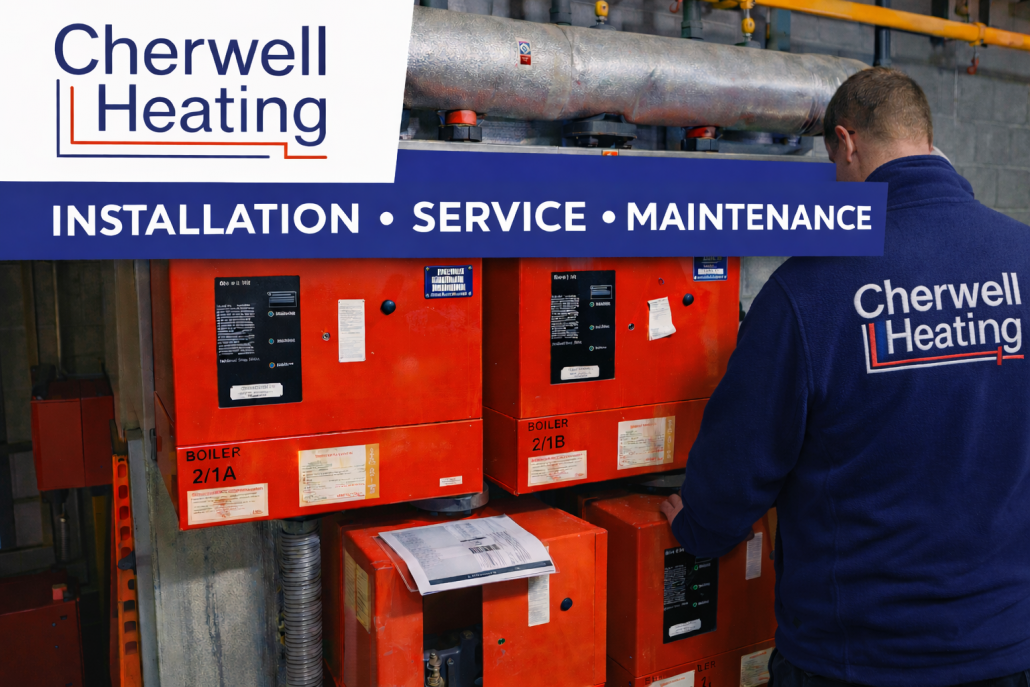
Commercial Boiler installation service and maintenance
Reliable commercial heating is essential for business continuity. Whether you operate an office, warehouse, factory, school, or industrial site, your heating system directly affects comfort, productivity, safety, and compliance.
At Cherwell Heating, we support commercial and industrial clients across Oxfordshire and Buckinghamshire with professional commercial boiler maintenance, repairs, installation, and commercial gas boiler replacement.
What Is Commercial Heating?
Commercial heating refers to gas boiler and plant room heating systems designed for non-domestic buildings. These systems are larger and more complex than domestic heating and are subject to stricter safety, efficiency, and compliance requirements.
A well-managed commercial heating system helps businesses to:
Maintain consistent indoor temperatures Reduce energy and gas costs Avoid unexpected breakdowns Extend boiler and plant lifespan Meet gas safety and insurance obligations
Routine commercial boiler maintenance is one of the most cost-effective ways to protect your heating system. Regular servicing keeps equipment safe, efficient, and reliable — especially during peak winter demand.
Without proper maintenance, commercial boilers are more likely to:
Fail unexpectedly Operate inefficiently and waste energy Develop safety or compliance issues Require expensive emergency repairs
A professional commercial boiler service typically includes:
Gas safety and combustion checks Inspection of burners and heat exchangers Pump, valve, and control testing Safety device verification Identification of worn or failing components
Early fault detection helps prevent breakdowns, downtime, and costly repairs.
Commercial Boiler Repairs: Act Early to Avoid Disruption
Prompt commercial boiler repairs can prevent small faults from escalating into full system failures.
Common warning signs include:
Inconsistent or insufficient heating Rising gas or energy bills Repeated fault codes or lockouts Unusual noises or pressure issues
Early intervention is almost always cheaper and less disruptive than emergency call-outs.
When Is Commercial Gas Boiler Replacement the Right Choice?
Commercial gas boiler replacement becomes the best option when repair costs rise and efficiency falls.
Replacement is often recommended when:
Boilers are old or non-condensing Breakdowns are becoming frequent Spare parts are difficult to source Energy efficiency is poor Building heating demand has changed
Modern commercial boilers deliver higher efficiency, better control, and lower operating costs.
Planned commercial heating work allows businesses to:
Control budgets and timelines Schedule works outside peak hours Reduce operational disruption Improve long-term performance
Reactive repairs are typically more expensive and disruptive than planned maintenance or replacement.
Why Businesses Choose Cherwell Heating
We work exclusively with commercial and industrial heating systems, providing practical, compliant solutions tailored to real buildings and real businesses.
Clients choose us for:
Gas Safe registered commercial engineers Experience across offices, warehouses, factories, and plant rooms Honest advice on repair vs replacement Clear documentation and compliance support Minimal-disruption working practices
From commercial boiler installation to ongoing maintenance, we deliver heating systems businesses can rely on.
Commercial Heating – Key Takeaway
Commercial heating systems require specialist maintenance and planned upgrades to remain safe, efficient, and reliable. Regular servicing reduces breakdowns, while timely commercial gas boiler replacement lowers energy costs and improves long-term performance.
Frequently Asked Questions About Commercial Heating
What is commercial heating?
Commercial heating refers to gas boiler and plant room heating systems designed for non-domestic buildings such as offices, warehouses, factories, schools, and industrial units. These systems are larger and more complex than domestic heating and require specialist design, servicing, and maintenance.
How often should a commercial boiler be serviced?
Most commercial boilers should be serviced at least once per year. High-use or critical systems may require six-monthly servicing to maintain efficiency, reliability, and compliance with insurance requirements.
What does commercial boiler maintenance include?
Commercial boiler maintenance typically includes:
Gas safety and combustion checks Inspection of burners and heat exchangers Pump, valve, and control testing Safety device verification Identification of worn or failing components
Is commercial boiler maintenance a legal requirement?
Commercial gas boilers must be maintained in a safe operating condition under UK gas safety regulations. Regular servicing is also commonly required by insurers, landlords, and facilities management contracts.
When should a commercial boiler be replaced instead of repaired?
Commercial gas boiler replacement is usually the better option when:
The boiler is old or inefficient Breakdowns are frequent Spare parts are unavailable Repair costs are increasing year on year
How long does a commercial gas boiler last?
A commercial gas boiler typically lasts 15–25 years, depending on usage, maintenance quality, and system design.
What are the benefits of replacing an old commercial boiler?
Replacing an ageing commercial boiler can:
Reduce gas and energy costs Improve heating reliability Lower carbon emissions Improve system control Reduce emergency repair call-outs
What is a commercial plant room?
A commercial plant room houses the main heating components of a building, including boilers, pumps, pressurisation units, valves, and heating controls.
Can commercial heating work be carried out with minimal disruption?
Yes. Planned commercial boiler maintenance, repairs, installation, or replacement can usually be scheduled outside peak hours or phased to minimise disruption.
Who should carry out commercial heating work?
Commercial heating work should always be carried out by Gas Safe registered engineers qualified for commercial systems, with experience working on non-domestic buildings and plant rooms.